Showing posts with label Christianity. Show all posts

Thursday, May 14, 2009

God's call to care for the world's orphans

I was doing my daily check of Ethiopian adoption blogs and came across an interesting fact in a post that is circulating.  Here it is:
  • There are 132 million orphans in the world, according to UNICEF.
  • There are roughly 2 billion people who consider themselves Christians in the world.
If all 2 billion believe in Christ as their Savior then all are adopted:

For all who are being led by the Spirit of God, these are sons of God.  For you have not received a spirit of slavery leading to fear again, but you have received a spirit of adoption as sons by which we cry out, "Abba! Father!"  The Spirit Himself testifies with our spirit that we are children of God,  and if children, heirs also, heirs of God and fellow heirs with Christ, if indeed we suffer with Him so that we may also be glorified with Him.
Romans 8:14-17

Therefore, if only 7% of Christians chose to adopt ONE child, all 132 million of the world's orphans would have a permanent home! 
 But wait...it gets better, if only THREE (yep, you read that 
correctly, 3%) of the world's Christians adopted ONE child, all adoptable orphans would have a permanent home and a forever family. That's all it would take!  
While I firmly believe that not everyone is called to adopt – Christian or not – I do believe that, at the very least, 3% of 2 billion Christians have been given this calling, especially since scripture defines the mark of pure Christianity as caring for orphans!  It's simply a matter of obeying the call and returning the enormous gift of adoption that God has given us to a child who needs a home.

Religion that God our Father accepts as pure and faultless is this: to look after orphans and widows in their distress.
James 1:27a.

Friday, January 16, 2009

Adoptive Families the Norm for Christian Families


So I'm reading the book "Passing On the Faith," by Merton P. Strommen and Richard A. Hardel in preparation for a class I'm going to teach at Concordia University- Wisconsin (pretty good read, by the way... if you're at all involved in family ministry or in ensuring that the children of your congregation are raised in the faith).  I'm not very far into it yet, but the first chapter talks a lot about how strong, life-changing families need to build and maintain two key relationship- a strong family relationship and a strong relationship with God.  The argument is that these relationships are two sides of the same coin and that the church needs to help families to encourage and support this sort of faith formation in the home.  The chapter then goes on to try and define what family is (you have to decide on what family "is" before you can try and address how to help it!).  It was in this context, then, that I came across this throwaway paragraph that speaks strongly to the notion of adoptive familes as normative for the definition of a Christian family:
As the first and most basic community, the family acts as a model for other, larger faith-learning communities. Diana Garland, director of the Family Ministry Project located at Louisville Presbyterian Theological Seminary, in Kentucky, defines family. According to her, the model of family that Jesus endorses is the adoptive family. The last act of Jesus' earthly ministry recorded in the Gospel of John enacts that adoptive model. Jesus turns to his mother and says, "Woman, behold your son." Then turning to the beloved disciple he says, "Behold your mother." The Church follows Christ by ensuring that no one in the family of faith is familyless- everyone is adopted into the family."                                        (revised edition,  2008,  p.23).
Not only do I agree wholeheartedly with this quote from Diana Garland, but I think it strikes right to the heart of what Maggie and I wish to do.  Although I believe Garland's intention was to state that the congregation itself functions as a family of believers, thereby ensuring that no one in the congregation be "familyless," still I think it speaks to our domestic families as well.  After all, it seems pretty clear that God is calling Christians to reach out in Christ-like love to many types of needy people- orphans being (if not foremost) at least prominent in that group.

God is speaking to His people through His Word, calling us to love one another as Christ has loved us (1 John 4:19),  the question for us is: are we listening?

Wednesday, January 7, 2009

Melkam Genna!

Happy Christmas (Melkam Gena) to you all!
According to Christian Orthodox tradition Christmas falls on January 7th.  A little less than half the population in Ethiopia belongs to the Ethiopian Orthodox Christian Church.  Christmas in Ethiopia is called Lidet (or Leddat) and is not the religious and secular festival that it is in the West.  On Christmas Eve, January 6, the city is crowded with pilgrims and tourists from all parts of the world.  The people remain outdoors all night, praying and chanting.   On January 7, the Ethiopian Christmas known as Ganna is celebrated.  The word Ganna is used interchangeably with the word Christmas, to mean the birth of Jesus Christ (Leddat).  Traditionally, young men played a game similar to hockey, called genna, on this day, and now Christmas has also come to be known by that name.  The preparation of the feast is an important part of the day in Ethiopia.  A typical Ethiopian feast for the Christmas meal includes a main course, such as doro wat  ( a spicy chicken stew), injera (a flat round bread) and homemade wine or beer.  The injera is used to scoop and eat the food, thereby replacing ordinary utensils.   Gift giving in an Ethiopian Christmas celebration is a very small part of this ceremony.   Children, if they receive gifts, usually receive simple presents such as clothing.

Monday, December 8, 2008

Byzantine influence on Gondarene Art

Gondar's founding occurred a little less than a century after Ethiopian Christendom came close to total destruction at the hands of the Islamic warlord, Ahmed Gragn, whose forces swept in from the east in 1528. Gragn's war on Ethiopian Christians was a catastrophe for the Ethiopian Christian church. The Christian highlands, from Axum in the north to the shores of Lake Tana in the west, were almost completely overrun for more than a decade and much of the cultural legacy of previous centuries disappeared. Hundreds of churches and artistic treasure houses were looted and burnt and the booty carried away. There is little doubt that Fasilidas and his successors saw their capital as a phoenix and so patronized the arts – they were rebuilding their culture and heritage.

Sculpture seems to have very few artisans and patrons in Ethiopia while there is a fascination with painting. It dates back to the beginnings of the Christian era at least; but the plundering of invaders meant that relatively little from earlier than the sixteenth century has been preserved.
The medieval school of Ethiopian painting was dominated by Byzantine influences, which is to say the Byzantine style of art, not necessarily Byzantium itself (whenever Byzantine art is used in this post it is referring to the style not the location). With the rise of this new capital and art patronage, the Gondarene artistic period formed from the historical tradition (Byzantine).

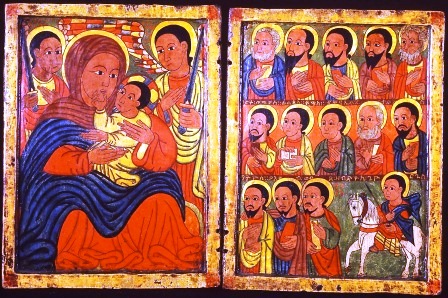
Byzantine art is marked by more symbolic approach to the subject matter as opposed to, say, Classical art, which attempts to be more realistic and less symbolic. The subject matter of Byzantine art is more often than not religious (Christian) or royal in nature. The most commonly seen examples of Byzantine art are usually mosaics and murals from churches or icons. Icons often depicted the Virgin with the Christ Child and, sometimes flanked by saints and angels. An Ethiopian example of an icon can be seen in this tempera on panel example, entitled Diptych with Virgin and Child flanked by archangels, apostles, and Saint George, from the late 15th century.


diptych-with-virgin-and-child_new.jpg

The Byzantine style of art can be identified by numerous characteristics. These are, but are not limited to:
1. The use of rich, bright colors (often the colors found in a Crayola 8-box of crayons)
2. Flat figures that seem to float on the surface and are piled on in a frontal pose
3. Detail is avoided and drapery is often simple and curvilinear
4. Large eyes and one facial type
5. Gold background

Many of these characteristics are seen in this mural that stretches across the ceiling at The Debre Berhan Selassie Church in Gondar. The ceiling is covered by hundreds of faces with wings (angels). All of them are a flat (2) facial type with large eyes (3) depicted with bright colors (1) on a gold background (5).

Even today much of the art in Ethiopia continues to reflect the cultural tradition that was reinvented at Gondar.

Ethiopian art

Gondar

Fasilidas was the emperor of Ethiopia (a hereditary position abolished in 1975) and a member of the Solomonic dynasty.  That dynasty is the traditional Imperial House of Ethiopia which claims descent from King Solomon and the Queen of Sheba, who is said to have given birth to King Menelik I (the first traditional king) after her visit to Solomon in Jerusalem.  Fasilidas is credited with founding Gondar in the mid-1630s.  Gondar is often called the Camelot of Africa becasue of its numerous medieval castles.  It is also famous for the incredible Gondarene art that graces its churches in the form of Byzantine murals -- the most famous of which is Debra Berhan Selassie.
The main castle was built in the late 1630s and early 1640s by the Emperor, who had architectural inspirations.  St Mary's of Zion in Axum, Ethiopia (seen below) is another one of his architectural creations.
Fasilidas was also responsible for seven of Gondar's 40+ churches , numerous bridges, a pavilion and a sunken bathing place,  which is still filled during the Timkat season with water from the nearby Qaha river.  Other structures date from later periods.   The grandson of Fasilidas,Iyasu the Great’s castle was described at the time by his chronicler as finer than the House of Solomon.  Its inner walls were said to have been decorated with ivory, mirrors and paintings  its ceiling was covered with gold-leaf and precious stones.  All of which has long sine vanished from th now gutted castle.

Iyasu's most impressive achievement may be the Church of Debre Berhan Selassie, the Light of the Trinity, which is still used as a church.  

While the building itself is plain, comprised of a simple thatched structure on the outside, the interior is painted with many religious and historical scenes.  The ceiling is painted with more than 80 angels’ faces all.  The north wall holds a depiction of the Trinity above the crucifixion.  The south wall has a mural of St Mary; that of the east wall the life of Jesus; the west wall shows saints.

It is believed that Fasilidas chose this location and name based on a legend which holds that an archangel prophesied that an Ethiopian capital would be built at a place with a name that began with the letter G.  This led to a number sixteenth and seventeenth century locations named, Guzara, Gorgora and Gondar.  Another legend says that while Fasilidas was out hunting God told him of the place that the capital was to be built and Fasilidas followed a buffalo to the spot.

Following the assassination of Iyasu I by his son, Tekla Haimanot came a struggle for control of the imperial throne during which period no significant structures where built.  Tekla Haimanot was murdered, the next successor was forcibly deposed and the next poisoned.  This all stopped when  Bakaffa came to the throne.  He left two castles -- one attributed to him and the other to his consort, the Empress Mentewab.

Iyasu II, Bakaffa's successor is considered the last of the Emperors of Gondar to rule with full authority.  During his reign, work began on new buildings outside the main palace compound as well as a city on the hills to the north-west of the city center known as Kweskwam.

Gondar remained the capital until 1855.  The city was a center of religious learning and art. Painting and music, dance and poetry, together with skilled instruction in these and many other disciplines, thrived for more than 200 years.  At the end of the eighteenth century a poet wrote:

Beautiful from its beginnings, Gondar, hope of the wretched!
And hope of the Great, Gondar without measure or bounds! 
0 dove of John, Gondar, generous-hearted, mother! 
Gondar, never bowed by affliction! 
Gondar with its merry name! 
Gondar, seat of prosperity and of savoury food!
Gondar, dwelling of King Iyasu and of mighty Bakaffa!
Gondar, which emulated the City of David, the land of Salem!
She will be a myth unto eternity! 


Monday, November 24, 2008

Ethiopian Monolithic Churches

I was thinking this morning that Maggie and I have embarked ourselves upon a journey. The path upon which we're traveling is oriented toward the eventual adoption of our youngest child from Ethiopia. As a result, I thought a post about some of the sights in Ethiopia might be appropriate to describe. In this post, I'll highlight one of the (little known) wonders of the world.

I'd like to introduce you to Lalibela, a holy city of the Ethiopian Orthodox Church and a pilgrimage site for centuries. It lies in the north of Ethiopia and the eleven churches there are regarded as one of the wonders of the world. They are all excavated -literally carved- right out of the bedrock. Carved into the solid rock, they are an immense maze of underground tunnels and passageways.


Ethiopian tradition says that they were carved in one night by angels. The legend goes that King Lalibela (the Ethiopian monarch in the late 12th to early 13th centuries A.D.) was carried off one night to the heavenly Jerusalem. There he was instructed to build the churches and that angels worked beside each men as they cut each one from the rock.


Some scholars, noting that the style of the Lalibela churches closely matches the architecture of ancient Aksum (the capital during Ethiopia's "golden years" of the 1st to 10th centuries) believe the churches are actually older than that- that some may in fact be converted palaces.
In any case, after King Lalibela's death, the city began to draw thousands of pilgrims coming to see the "new Jerusalem." The people of Ethiopia have a saying about Lalibela that goes like this: "If you do not wish to see Lalibela, you are like someone who has no desire to see the face of Christ."
Led by Him